Tuesday, March 6, 2018

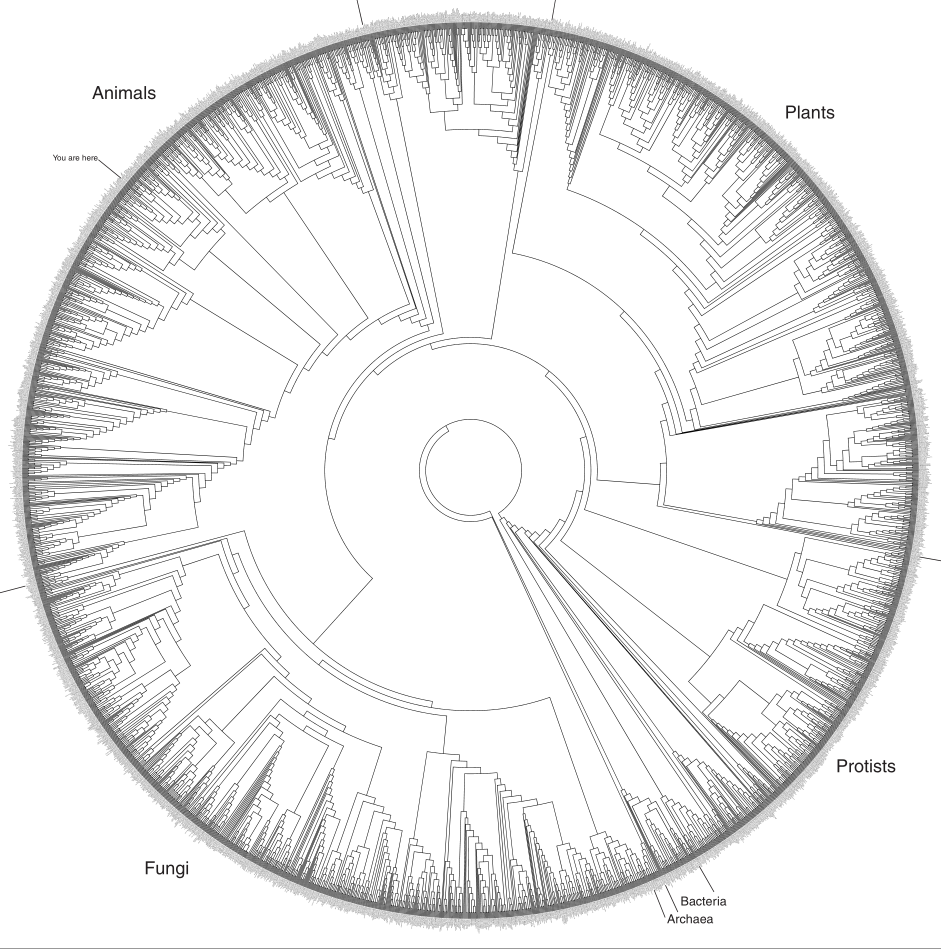
The Tree

Published in Science in 2003, "The Tree" is the most elegant visual representation of data I've ever seen. The information density of this figure is extraordinary. It's a phylogenetic tree of all Earth life with a time dimension. The center of the figure is the formation of the Earth and the inner circle is the emergence of life. As you move further away from the center you move closer to the present. The curve segments on the perimeter represent kingdoms, and within them phylum, etc.
What's more impressive still is that even while being as efficient with space as it is, the purpose of this diagram is also to be beautiful. It inspires awe and the diversity of life while simultaneously emphasizing its oneness. It appears both like the Earth itself and like a human iris, suggesting discovery, insight, and identity. The seamless weaving of hard geometric lines and smooth curves suggests the technological and the organic. Like a fractal, the Tree portrays complexity at every level of magnification. This more than a diagram of life on Earth, it's a portrait.

(See Science, 2003, 300:1692-1697).


Sunday, July 9, 2017

The tragedy of US-Russian relations

On a serious note, I really do think better US-Russia relations are a good thing for both countries and for the world. Yet I'm not hopeful that will happen in a meaningful and enduring way until all the Cold Warriors on both sides are dead. One of our most important and somewhat moderate statesmen, Sen. John McCain, asserts on national television that the Russia is "a gas station masquerading as a country." Sure, Russia's economy is overly dependent on oil and gas products, but have we any thought to what a shitty, casually insensitive thing that is to say? They hear that, of course, and all that from a country that doesn't even have its own language. Russia is an ancient culture with a complex history. It's contribution to the arts, humanities, and sciences are immeasurable. They sacrificed more for the sake of defeating the Nazis in Europe than the rest of the world combined. Very real horrors have to Russia from Western Europe--far worse than anything the United States has ever experienced in its brief history. Do you remember the time 1 in 10 Americans died in a war for national survival? Of course you don't, but the Russians do because it happened within their living memory. Yet we regard their security concerns as paranoia to be to teased, while we are waging "preemptive wars" with middle-sized countries because they may someday be a threat also in the name of security. Better relations between states, as between people, begins with respect--and to get it you have to give it. We don't. They don't. If they are nothing but a "gas station masquerading as a country", then we are Walmart doing the same. And so the tragedy of great nations continues.
Here is the Kuban Cossak Choir singing a song about the Turko-Russian wars that began long before the "United States of America" was even a dream. Enjoy.

Monday, February 6, 2017

On the nature of intellect and delusion

http://www.chicagotribune.com/news/opinion/commentary/ct-trump-voter-happy-deplorable-perspec-0206-md-20170203-story.html

____________________________________


The author writes, "

I am weary of lectures about what values I should have and how insensitive I am. I am tired of being "guilted" for having a job, finding a way to live comfortably and having a practical sense of priority on global warming. I make choices and decisions based on what can be done and what I can pay for, not on what is said or promised. I don't carry signs, chant, dress up in clever costumes, vandalize or wear pink hats.


But all that doesn't matter. My grandchildren should make these choices themselves, not the current collection of Washington and state government politicos who use my taxes to make empty speeches and buy votes in the next election. Balance the budgets and pay off state and federal debt first. And then we can have all the empty values-centered debates about which cause du jour we want to throw money at.

It seems that the outcome of the last election is understood only by people like me. Frankly, I don't like Donald Trump either. He is arrogant, careless with what he says, overly competitive and insensitive.

I voted for Trump because he was the alternative to letting a collection of free spenders, organizers, race-baiters, intellectuals, tree huggers and professional value arbitrators continue to spend our grandchildren's money."

_______________________________

This kind of thinking is common, contemptuous, and dangerous. It's dangerous because there is more than a kernel of sense in what the author is saying, but this only serves to give a broader delusion credibility. There are legitimate criticisms of the institutions that person thought they were opposing when they voted for Trump. What makes it dangerous is the seamless mix of reason and unreason. The claim you bolded is begging the question, assuming that the daily, practical contexts wherein this individually must choose to deprioritize global warming are not shaped by national-level policies, some of which may actually be efficacious in shifting the home economy. The author subtly assumes with justification the primacy of debt repayment as the determinant their grandchildren's' quality of life. I hate this crap because it shows the horrifying extent to which humans utilize their intellect not to apprehend truth by questioning what is believed, but to defend what is believed. This person, for whatever reason--perhaps because debt management has been an ongoing challenge for them personally, perhaps because a black man was president when they were told the debt was a problem--believes debt is the most important thing and for some reason we can only speculate upon doesn't believe global warming is a problem. Everything else is just an elaborate fancy spun around those beliefs to make them appear more reasonable. They didn't vote for Trump, they voted for the guy with an R by his name, just like they always do.

Friday, November 11, 2016

The DNC must be dismantled or reconstituted

The scope of the DNC's failure is catastrophic. Yet not a single mea culpa. Nobody accountable. The party itself should be dismantled or reconstituted, beginning with a grassroots movement. I will no longer accept that it it's good enough for the Democratic Party to just "be right". They have to win, too. And when was the last time they did that? Certain individuals who are Democrats occasionally win, but it's because of their own talents (i.e., Kennedy, Bill Clinton, Obama, Jerry Brown, Sanders). They win despite the Democratic Party, not because of it. The Republicans control everything--not because they're right--but because they're good at winning. We need a party that wins. The cronyism, corruption, and arrogance of the DNC leadership cannot win.

I mean christ... I won't even start on their willful ignorance of a nationwide, not-necessarily partisan, popular movement against the very establishment their candidate represented (rightly or wrongly), but what in heaven's name were they doing campaigning in Arpaioland Arizona while Democratic strongholds like Wisconsin and Michigan are slipping? No, "of course they'll vote Democrat!. We're the party of the working class!" Really? When was the last time the Democratic Party was the party of the working class? The Carter Administration? They have completely taken their base for granted for long that they aren't even a part of the conversation anymore, except as an adversary, to such an extent that a billionaire real estate mogul took it from them and beat them with it.

And then how did HRC and the DNC react to their base having slipped away? She called them "deplorable", casting them to racists and sexists, and thereby dismissing their often valid criticisms and real economic hardships underlying. On the left, critics presenting real concerns for her viability as a candidate were silenced with terms like "Bernie Bros", containing the non-so-subtly veiled suggestion of sexism. So what happens? An actual racist, sexist bigot who at least pretends to be listening to those hurt most by the transformation of the global economy, at least pretends to listen to them, offering at least some vehicle through which to express their grievances, picks them up. If only there had been another candidate who could have offered these people a political language based on socioeconomic class instead of race, enabling broad-based mobilization against their true, neoliberal oppressors! (Hint: there was). Oh, but that wouldn't please the real beneficiaries of the establishment politics HRC respresnts. The DNC deserved this loss. We didn't. The people of color getting harassed and beaten in the streets don't deserve this. The hapless and misguided Trump voters who think something good is going to come of a right-wing proto-fascist movement don't deserve this. But the DNC does, for their shocking incompetence, for their arrogance, for rigging the primary for a fundamentally flawed and out-of-touch candidate. They must be dismantled.

Monday, October 10, 2016

Clinton V. Trump debate "Round 2", as billed by the media.

Watching debate last night, I asked myself "How did we get here?" And I think this an important question we shouldn't just forget about after Hillary Clinton wins. Because we're still "here". Donald Trump is a symptom, not a cause. A Hillary Clinton victory doesn't mean we're cured, only that we're not dead yet. We will still be a fractious, superficial, unsympathetic, and fear-ridden society of dubious temperament for democracy. For example, right now you can't get over my using the world 'temperament'. It's like that cell of meaning in the body of our culture has died, fallen to our disease. It's yet another casualty on the ever-growing lists of thoughts we can no longer have. Soon, I fear, a language of understanding this question--or any question--may be beyond our capacity, inevitably the world of our minds decaying quickly into the primordial confusion from which we (the constitutional 'We') have sprung.

Saturday, November 14, 2015

Responding to the attacks in Paris 11/13

Class,

As many of you know there has been a series of coordinated in Paris. For the next week or so the media coverage of the events will be pervasive. Here are several objectives to keep in mind.

1. Don't panic. You are safe. Some of you may have friends or family in Europe and they are safe, too. Remember that terrorism works by exploiting the natural human responses to 'terrifying' events, meaning that the psychological effect is the goal, not the physical effect. The purpose is to induce people into acting and thinking irrationally. When you keep your wits about you, you take away their power.

2. Be reflective. We are all experiencing a variety of emotions in response to this. No matter how many world politics courses we've taken, we are all human. Take time to reflect and recognize the emotions acting upon you, the good and the bad, the empathy and the anger. Emotions can influence our decisions and these events are designed to manipulate our emotions. However, by identifying these emotions, we can recover some of our own agency.  

3. Don't believe everything you read or see on TV. This doesn't mean believe nothing. These are the sorts of events that separate the real, hard news organizations from the chaff, the sensationalizing tabloids seeking only to maximize ratings. High quality news organizations will in most cases wait until facts have been double or in some cases triple verified by reliable sources, such as eye-witnesses, emergency personnel, or government officials. While we all hunger for the latest information, we must be patient. As we hunger for the latest details, the less ethical news outlets are more than happy to serve up rumors and unverified information to keep you tuned in. Such rumors are often meant to appeal to our instinctual fears and prejudices. Be patient and the facts will come out.

4. You are students of world politics, not randos off the street. Use your knowledge and skills to analyze the situation coolly and methodically. As the facts become known, consider the attacker's objectives, who the target population is (i.e. whom this event was supposed to terrorize), anticipate reactions and counter-reactions. How do the attackers expect us to respond? Who will we act upon and how will they respond to that? Play this out step-by-step, several steps ahead. As more facts become known, continually adjust your explanations to be consistent with and to incorporate those new facts. Discard explanations that are inconsistent with the facts, retain only those (and there may be more than one) which are. Do not become emotionally attached or invested in your initial ideas; be intellectually flexible.

Good luck.

Tuesday, June 16, 2015

Nothing is true. Everything is suspect. Even our own feelings.

“Believe in yourself.” What does this really mean? People often use it in reference to some personal or professional objective, which we believe we could accomplish. But could this also be another way of saying ‘trust your feelings’? Perhaps it would be beneficial to think of it this way. This statement, of course, implies that our feelings are somehow suspect, possibly misleading, or otherwise unworthy of trust. I think that if anyone ever explicitly told you this proposition was true you would be incredulous. If, however, this proposition is implicitly suggested we may carelessly heed it. Pause and reflect a moment and ask yourself “have I ever been made to feel like my feelings are invalid?” A romantic partner might have done this. Maybe a parent or an authority figure. I’m suggesting it might go deeper than this. For example, consider the notion presently prevailing in the academy the doctrine of subjectivism. Subjectivism is the idea that there is no absolute, “big tee”, Truth. Everybody’s internal apprehension of truth is equally valid.  At first consideration we might receive this as implying “All of our truths are valid”, yet clearly this is impossible, for there countless cases where two propositions are logically precluded from bother being true at the same time. Elvis cannot be both alive and dead. Either one of these is possible and may be true at different times, but not at once. The only remaining way to reconcile the notion that two individuals beliefs, even if mutually exclusive, with the restriction that they are equally valid is to say that they are both equal in their invalidity;. Elvis is neither dead nor alive. In other words, the only we our truths are equally valid is if they’re equally untrue.  These days we typically apply this principle to our respective Gods, now demoted to mere gods at best. At worst, they’re all banished to the realm of mythology. We often apply them to our political beliefs, ideologies and moral values. Indeed, moral subjectivism is probably inevitable after our Gods are gone. So what about our beliefs concerning our feelings? If consider the proposition I am sad, how can be sure this is the case?  Well someone else may very well believe I am happy. If I feel angry, I should act out on that feeling if justice is to be had. Acting out might include behaviors like yelling or acting aggressively toward someone. But perhaps my anger is invalid? If that’s so then acting out on it would be unjust. In the interest of justice, we then swallow our anger, our sadness, and even our happiness.

Friday, May 29, 2015

The problem of the "pleasure dial"

A common theme in science fiction today is the question of "mind uploading." As neuro- and cognitive scientists reverse-engineer the workings of the brain, the biological organ which produces the mind, we are increasing interested the possibility of replicating nature's technology. Using a sufficiently powerful computer, we might simulate a brain in all of its neural complexity, thus establishing a platform upon which to emulate a mind and even consciousness. In fact, attempts are currently underway to simulate the brains of mice (http://bluebrain.epfl.ch/).

Supposing we attain the technical prowess to emulate a human brain and all its outputs, including mind and consciousness, raises many questions which are both interesting and troubling. This is a favorite variety of question among science fiction authors and philosophers, who have now spilled many electrons before them. For example, if a virtual human is emulated on a computer, would wiping that computer's data constitute murder? This theme was taken up in the recent film Ex Machina. A secondary theme the film delved into was the titillating question of whether a virtual being should be programmed to experience corporeal desires. Aren't our sex drives and appetites essential elements of the human experience? If not for these desires, to what might consciousness be directed? In another recent example out of Hollywood, Transcendence, a young scientist (Johnny Depp) succeeds in "uploading" his entire neural connectome to a computer, thus creating a virtual copy of himself. Shortly thereafter, the scientist is assassinated. Those he left behind must take on the question of whether or not the virtual copy is really him. The digital Depp claims that he is, and by all accounts appears to possess the memories, sentiments, and dreams of the man who died. But how can we be sure?

Technological developments that raise exciting possibilities for the future also tend to attract attention among science fiction authors and philosophers. Certainly the possibility of uploading our minds to a potentially faster, more upgradeable, and longer lived platform than the 3 lb glob of fat between our ears excites us. By uploading, we may transcend the limitations of biological existence, unlocking the possibilities of exponentially increasing intelligence and functional immortality. Living as informational beings, we are unhindered by physical mass. Able to travel at the speed of light, the confines of time and space can no longer hold us. The universe thus opens up to humanity and a truly space-faring civilization becomes possible. I could go on about that one.

With these possibilities, of course, come new fears. One of the problems that worries me is what I call the "pleasure dial." If our senses and appetites are virtual, why can't they be tweaked so that I feel joyful all the time? Or better yet ecstatic? What's to stop an individual from cranking the pleasure dial full blast, achieving a state of ecstasy that never ends? It would be the theoretical maximum of happiness and satisfaction. Bliss unadulterated by any form of want. Why would anyone ever want to leave this state since it is by design perfect? I wouldn't. And nobody else would. So what then would come of humanity? What would inspire us to do new works? I fear we will reach a stable equilibrium, wherein we are all locked away in our own private euphorias. And in such a condition we would persist, unmoving and unchanging, until the power goes out. And when it does, there will be nobody around to fix it. And that is how humanity would end.

Tuesday, March 31, 2015

Once again, the GOP announces to the world that leaders should not expect the United States to abide by commitments made by the President. According to Senate Majority leader Mitch McConnell, “Considering that two-thirds of the U.S. federal government hasn’t even signed off on the Clean Power Plan and 13 states have already pledged to fight it, our international partners should proceed with caution before entering into a binding, unattainable deal.”

New York Times: http://www.nytimes.com/2015/04/01/us/obama-to-offer-major-blueprint-on-climate-change.html?_r=0

Wednesday, October 29, 2014

On certainty

If it were the common practice to speak only when one is certain, then the only people speaking would be the idiots.

Wednesday, October 22, 2014

Social media and the suppression of creativity


"The world in general disapproves of creativity, and to be creative in public is particularly bad. Even to speculate in public is rather worrisome ...[I]ndividuals must, therefore, have the feeling that the others won’t object.” - Isaac Asimov

What does this mean for us now that our entire lives are spent in the public eye? Isn't recycling an old idea I expect to be 'liked' a better social strategy than venturing something new, untested, and unsettled as a matter of public good taste?

Some words for my students on Yik Yak, freedom, and personal responsibility

As new things are wont to do, they scare the crap out of old people.

As old people are wont to do with new things they don’t understand, they try to take them away from those who they perceive as less responsible than them.

Personally, I’m glad you have a place like this, where you can feel somewhat secure in your anonymity to say anything you want. In this post-911 world—your world, the only world you have ever known—these sorts of places are becoming worryingly few.

Virtually anything we say or do now is potentially under the eyes of surveillance, which means all is under surveillance. There is no relevant difference here.

I’ve surveyed Yik Yak a bit on my own. In my opinion most of it is trivial, some of it beautiful, and some of it ugly. But this is the nature of speech, is it not?

And who is to judge? Me? Some administrator? Your parents?

Though the knee-jerk reaction of many is to bend these rules, the laws of this land still guarantee adults certain unalienable rights, that among these are Life, Liberty, and the pursuit of Happiness.

But children are not afforded these rights.

Let me remind you of something because there are those who will tell you, or at least treat you otherwise---You are not children. You are adults. To be an adult means you make decisions for yourself, the fruit as well as the consequences of which shall be yours alone.

You are adults like the world has never seen—a generation unique to this time, this place, your own histories. Old people will understand you more than you think, but less than they think.

They will look to you as the source of degeneration in the world. But since when have they done any better? You live in the world they made for you. Is it perfect?

In these years of college the world will be rent open for you, its inner-workings exposed for you to inspect. You, as all previous generations, inherit the world’s problems to solve in the way you see best.

Perhaps in their advanced age, your elders now feel that their time to make the world a better place has run short and their work left incomplete. Hence, they fear control slipping away from them to you.

So stubbornly they grip tighter, grab and pull what is yours by rights and is the simple fact of the matter.

You are adults. It’s your world and you own it. Your choices make the world of tomorrow—the good ones and bad ones.

I will not tell you whether or not you are permitted to use Yik Yak or what to do with it, and I will do what little I can to see to it others don’t either.

But ultimately this is your free speech and thus your responsibility to protect it. And they will come for it. The first time somebody uses it for something dastardly, they’ll commandeer all of the airwaves, the copper, and the fiber to make sure everybody sees it—to make people afraid, to convince other old people that they need to protect their children, and to convince you that you must be protected like a child.

So we all make a devil's trade—an ounce of security for a pound of liberty.

And thus, the world of tomorrow is created by our choices, our actions.

Saturday, October 11, 2014

I want to explore the Darknet.

I don't know what's there. I have every right to be there.
I won't violate intellectual property rights or view child porn.
But if I don't do anything illegal, they are doing something illegal.
This isn't the Soviet Union and I'm not going to start acting like it.
Because if we all started acting like it was, it mind as well be.

I'm a political scientist, and have both the right and a legitimate reason.
Not that I need a legitimate purpose, because my right is already sufficient.
I'm interested in ISIL propaganda. I'm a scholar. I want to study it.
I'm also afraid of going to the sorts of websites I'd need to go to in order to view it.

Do you know what that means?
That means America is broken.
Freedom is broken.
The first stage is of censorship is self-censorship.

The scary thing, I think, is something that we all know.
In the scope of human civilization, freedom is the anomaly.
The default state of human society over the centuries has been tyranny.
We achieved something rare, hard gained and lost relatively easily.
Should we lose it now, how many tens, hundreds, or even thousands of years will it be before it regained?

Saturday, September 27, 2014

An atheist monk's prayer.

We are a nation of Atheist monks only pretending to know Jesus.
Me, I'm just learning to fit in.
I have stuff now. It's great. It means I exist.
My existence is made tangible, apprehensible. I am knowable to others by the quality and form of my possessions.
I have furniture I don't even use. It's just there to fill the empty space.
The empty space that was in my soul is now physical volume, and can be filled with stuff.
Stuff is like food. You fill up on it and you're satisfied for a while.
When the pangs return you take another meal. Stuff is food for the soul.
And only stuff guarantees a modicum of afterlife, for we live on in the form of our estates.

Wednesday, May 28, 2014

Evolution of Universes

The suitability of our universe for the evolution of life is incredibly unlikely, which means there were, or are, many failed (or failing) universes.

This implies that a diversity exists in universes, such that some support life and others don't--or perhaps suitability for life falls along a spectrum. 

If it's somehow possible to create universes, and it must be possible since there are universes, then it's possible that the life in some universes will figure out how to do it.

Universes in which life learns to create new universes will likely create them to be similarly hospitable.

Such hospitable universes, as such, would then, over "time" increases as a proportion of all universes.

Given enough time, virtually all universes may be hospitable to life.

If the universes most suitable to life create universes faster still, as they might since there will be more life within them to do this, then given enough time any given universe can be assumed to be teeming with life.

Given the immensity of the cosmos, it would be incredibly unlikely that we should happen to exist at it's relative youth.

This point is further emphasized by the exquisite harmonies we find in our own universe, and thus we may assume it to be the most "recent" in a very, very old line of progenitor universes.

We know this universe is suitable for life. But what's even more fascinating is that our best guess is that it isn't even rare. Rather, our universe is likely to by one among countless others that are teeming with it. 


Monday, May 5, 2014

Open letter to FCC Chairman Tom Wheeler

May 5, 2014

Dear Chairman Wheeler,

Ordinary Americans have had a hard run over the last 13 or 14 years. We’ve seen economic bubbles burst, our retirements and savings lost, and our tax dollars squandered on expensive foreign wars. Successive waves of banking and media consolidations have left banks too big to fail and the media with interests conflicting with those of the public. In this time we’ve been compelled to accept increasingly invasive security measures in our airports, in our shopping centers, and even our schools and homes. With each passing month, new leaks of classified documents add evidence for the regrettable conclusion that we, the United States of America, are now a surveillance state. And now a series of landmark Supreme Court decisions have irreversibly shifted the balance of ultimate authority in this country from the broad base of the public to a small, but deep-pocketed and well-connected elite. The one thing we really had going for us has been the widespread adoption and of the greatest tool for the promotion of intellectual freedom, free thought and free speech, since the movable-type printing press: the Internet.

In no time in history has human kind ever come so close to realizing John Stewart Mill’s ideal of an efficient marketplace of ideas. All that we have achieved in this venture, from the vast repositories of universally accessible knowledge to communication tools which have given voices to the voiceless, have been made possible through the historic enforcement of so-called Net Neutrality rules. It is the digital expression of the democratic ideal that something revolutionary, something wonderful, can come from anyone anywhere. And time after time it has.

Mr. Chairman, as you consider the adoption of new rules undermining the principle of Net Neutrality, please keep in mind that this decision could very well be the hammer that drives the nail into the Democracy’s coffin. The long term consequences of such an institutional change are always difficult to predict, but we know that enormous corporations lobbying for the changes will be in a position to remake the Internet in a way that disproportionately reflects their narrow economic interests. We can expect fewer people making decisions over what and how people access information, which will inevitably translate into diminished access for the little guys. Perhaps worse, the presence of such “gate keepers” creates opportunities for corruption and collusion between large power brokers who desire to influence the content of public discourse to suit their interests.

Our legislators are unresponsive, now firmly in the grip of corporate power and can no longer be counted on to do anything in the public interests that runs against the interests of their patrons. In court, our rights are only as good as our lawyers, and they have better ones. So many of us don't even realize how important this issue is the future of our country. Not coincidentally, the cable and public airwaves are dominated by a handful of unimaginably wealthy companies that control virtually everything that passes through them, save the Internet. It’s our last bastion of true equality and freedom. Save the Internet. No "fast lanes". Treat all data equally

Thank you for your time.

Submit your own comment to the FCC (14-28) proceeding number : http://apps.fcc.gov/ecfs/upload/display?z=hvz4a

Wednesday, April 16, 2014

Beasts of this Earth.

I think the greatest disappointment of the last 50 years or so is the building realization that we are not the gods we imagined ourselves to be.

Just beasts of this Earth.

In our culture we have always imagined ourselves to be above the animals, but before we had God to remind us that we weren't gods.

Now God is dead and we've gone on ahead of ourselves. Now reality catches up and we're no longer even afforded the comforting myth that we were created in God's image.

Just beasts of this Earth.

But aren't we sophisticated beasts? Sophisticated enough to see what we are, innovate a morality of our own based on aspirations to something higher, yet be unable to live up to it.

This is the root of our disappointment. Our liberated minds want equality and freedom but our bodies do not. Our bodes just want security and the best genes for their offspring.

If not with our words, our deeds reveal who--or what--is in control.

Just beasts of this Earth.

Thursday, April 3, 2014

On Big Data and the Human Spirit

Big Data is more human than traditional data. This is in part because traditional data, in terms of scale, is so much more directly manageable. It’s still pretty hands on, especially in the social sciences. This means that over time we’ve gotten very good at working the human element out, or at least minimizing it. Big Data, not necessarily because of its size, but because of its indirectness means we have a great deal less control over where and how it’s collected. Moreover, it’s often collected as the electronic traces humans leave behind as they go about their lives. That’s all they typically are traces—not a data point in the traditional sense. When you conduct your own survey or download the General Social Survey, each data point is an answer to a question. You know what the data point represents. This isn’t so with Big Data because all your data points really are is a clue. And in order to know what it means, you must exercise that quintessential human faculty of sensemaking. Accordingly, modes of sensemaking are as diverse as we are, each with our own unique brand of it rooted in our upbringing, education, experience, chance, and perhaps even our genes. There is a growing library of techniques, or algorithms, available that may assist the analyst in generating sense from Big Data. That means use routines in order to sift through the universe of clues to find the patterns that tie them together into meaning. But while computational and likely embedded math and logic, they are not mathematics or logic. Those are closed systems of self-referencing definitions, defined by their inventors as perfect. The Pythagorean Theorem only works perfectly with imaginary triangles because no perfect triangles are known to exist. On the contrary, algorithms are merely the computational expressions of someone’s own sensemaking faculties—an externalized digitalization of a human mind. When you begin to create your own algorithms, you’ll be uploading a small bit of yourself to carry on your own human uniqueness inside a macroscopic, but highly simplified, virtualization of the real world.

As the science of Big Data matures, I expect to see a resurgence of the humanities and psychological sciences. Big Data’s promise, of course, is that it stands to give us a greater lens on humanity than ever before. But in fulfilling this promise, we will necessary reach advancements in our understanding of the human being as a thinking and feeling being, which may in the end, allow us to transcend entirely the limitations we’ve forever imagined ourselves to be bound.

Wednesday, April 2, 2014

The problem with polarization

The lasting hangover following this binge of politically partisan fervor will be that even moderates regard each other as partisans. Tragically, moderates were the ones who had a chance of finding common ground and making incremental progress. 

McCutcheon v. FEC is a blow to American democracy.

In the McCutcheon v. FEC decision (download here) the Supreme Court argues that people would be "delighted to see fewer television commercials touting a candidate's accomplishments or disparaging an opponent's character." The decision continues "[m]oney in politics may at times seem repugnant," tolerating speech we don't like is just the price we have to pay for our First Amendment rights. This seems to reflect a fundamental misunderstanding of what people are concerned about. No, nobody likes the endless campaign ads, but we're not upset because they're interrupting Dancing with the Stars. The proper conception of the problem that respectfully acknowledges the concerns of ordinary citizens is that unlimited campaign donations as free speech implies that people with more money get a bigger voice. We cannot ignore the embedded moral hazard, i.e,. the perverse incentives that encourage politicians to screen out the masses in favor of a handful of really, really big donor fish. Rather, the Supreme Court argues talk of corruption must be constrained to clear cases of quid pro quo, dollars-for-influence transactions. I'm sure these Justices are not so naive that they don't realize such claims, like perjury, are virtually impossible to prove.

What's most worrisome is how accepting we, collectively, have become of this practice. Enshrined in the court's decision is the argument that the current aggregate limit on campaign contributions from individuals to candidates ($48,600) allows individuals to contribute the per-candidate maximum of $5,200 to a mere nine candidates! According to data acquired by OpenSecrets (cited at FiveThirtyEight), this deeply unfair limitation on free speech applies to fewer than 600 people. Setting all the high-sounding legal philosophical debate aside for a moment, why are the Supreme Court's priorities such that they are willing to gamble with the liberty of hundreds of millions, for fear that one of these precious few 600 should be denied the opportunity to buy themselves entire legislatures? I argue that this is because this kind of corruption goes well beyond quid pro quo. In politics--as in most everything--priorities follow money. Money has the power to set priorities, by "taking something all the way to the Supreme Court!" Could you do that if you felt your rights weren't respected? No, because you don't have money, and as long as money is equated with free speech nobody will have time to listen to you. Competition ensures that those who attempt to defy this rule lose out to those who heed it. Natural selection.

This 5-4 decision (along party lines) is yet another blow to the integrity of American democracy. It's a hack from the most undemocratic branch of government (by design) that shifts the allegiances from the (by design) most democratic branch of government away from their popular constituencies to a small club of landed patricians.